On This Page›
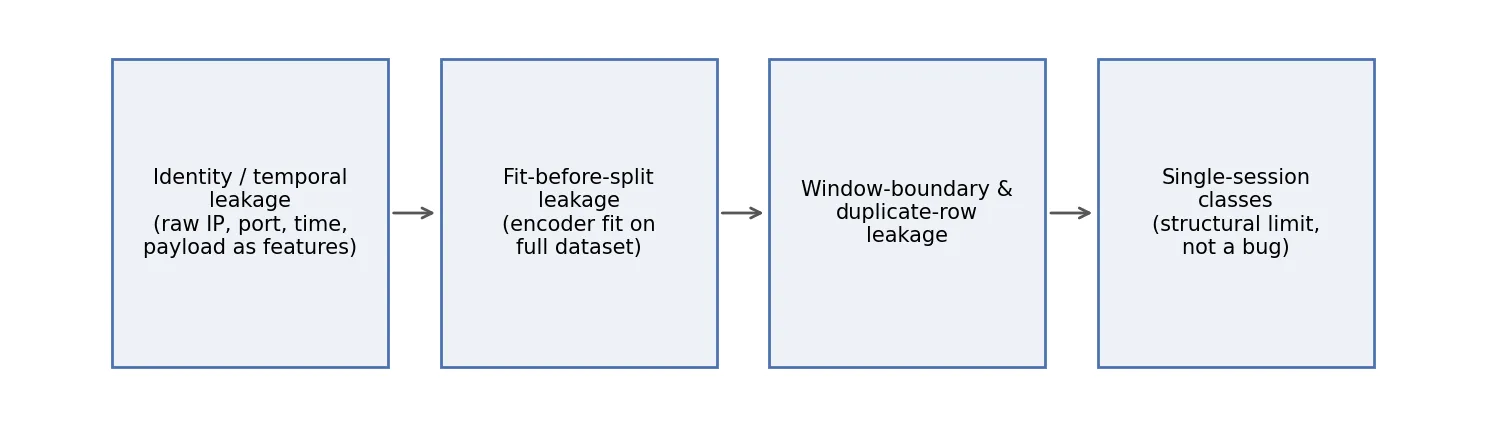
TL;DR. I trained Random Forests to detect attacks in IoT network traffic. The first notebook reported 99.97% accuracy. It was almost entirely leakage. Fixing it took four rounds of debugging, each one uncovering a subtler leak than the last. The final, honest evaluation shows reliable detection for only some attack types, and proves that four of the ten classes cannot be evaluated at all with this dataset, no matter what model you use.
Full two-column paper: download the PDF report.
1. The problem
IoT devices get hit by floods, scans, and credential attacks constantly. Traffic-based intrusion detection frames this as supervised classification: given features of a packet or flow, predict whether it is benign or which attack it belongs to.
I used the ACI-IoT-2023 dataset, specifically the payload-level export (ACI-IoT-2023-Payload.csv). Each row is one packet with ten raw fields:
| Column | Kind | Meaning |
|---|---|---|
srcip, dstip |
identity | Source / destination IP |
sport, dsport |
identity | Source / destination port |
protocol_m |
categorical | Transport protocol |
sttl |
numeric | Source TTL |
total_len |
numeric | Packet length (bytes) |
stime |
numeric | Capture timestamp (epoch) |
payload |
raw hex | Packet payload content |
label |
target | Benign + 9 attack types |
The interesting part of this project turned out not to be model selection. It was evaluation validity.
2. Data exploration
Severe imbalance, in two senses
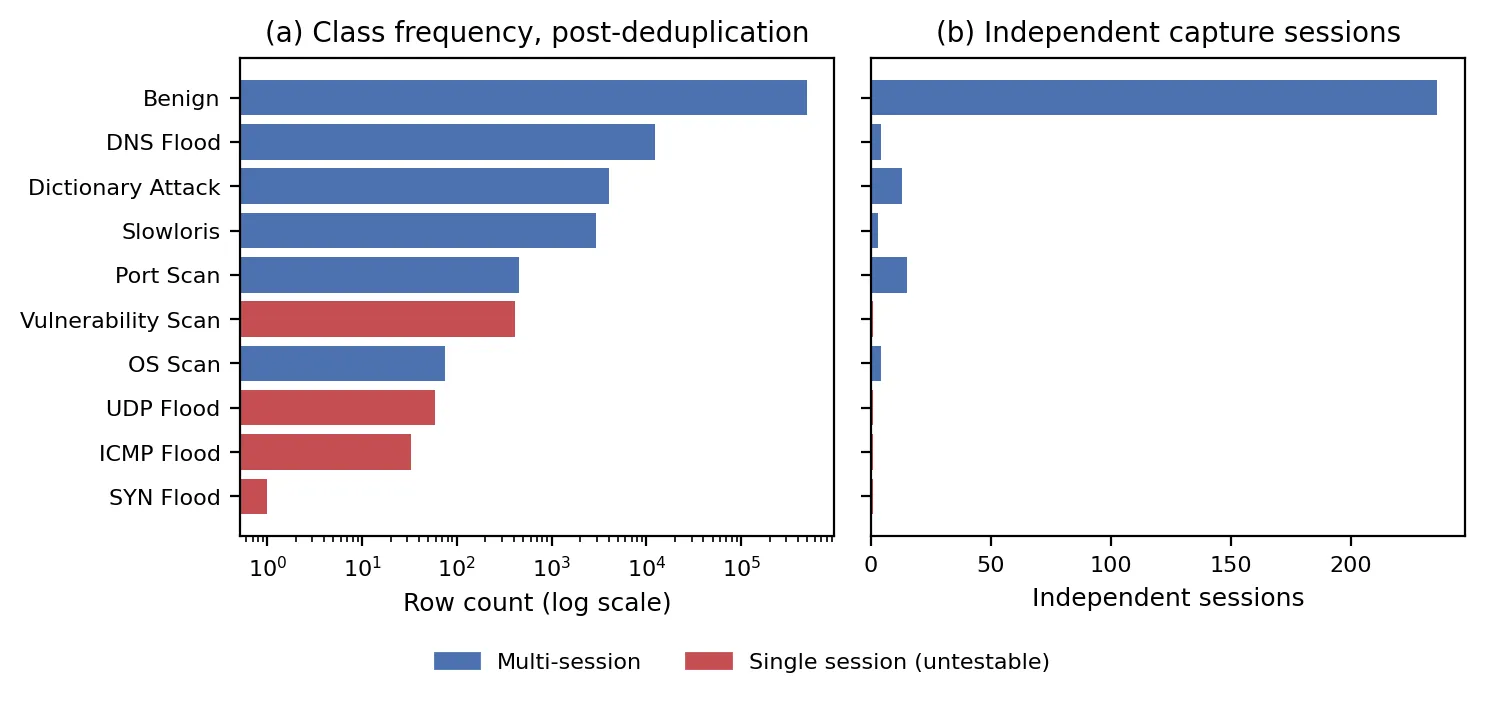
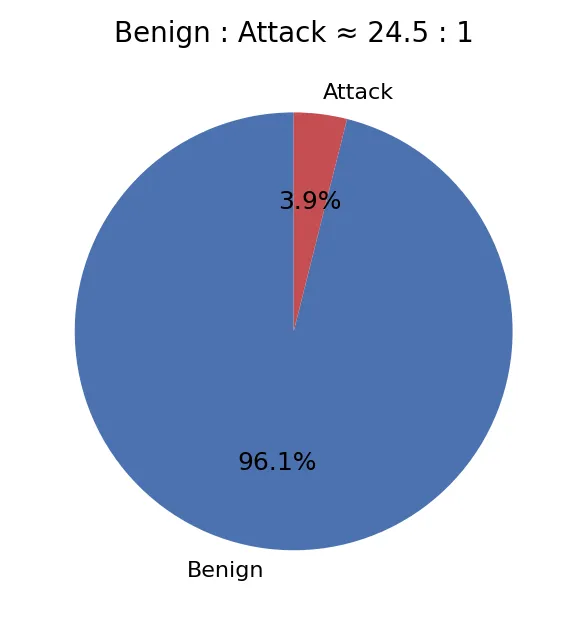
After removing exact duplicates there are 499,147 Benign rows against 20,381 attack rows across nine categories, roughly 24.5 : 1. Inside the attack classes the spread is far worse: DNS Flood has 12,397 rows, while SYN Flood collapses to a single row once duplicates are removed.
The hidden structure: sessions
Row counts hide something more important. Splitting each class into sessions (contiguous bursts separated by gaps over 60 seconds) shows how the capture was actually generated:
| Class | Sessions | Rows (post-dedup) |
|---|---|---|
| Benign | 236 | 499,147 |
| Port Scan | 15 | 454 |
| Dictionary Attack | 13 | 3,989 |
| DNS Flood | 4 | 12,397 |
| OS Scan | 4 | 75 |
| Slowloris | 3 | 2,962 |
| ICMP Flood | 1 | 33 |
| SYN Flood | 1 | 1 |
| UDP Flood | 1 | 59 |
| Vulnerability Scan | 1 | 411 |
Four attack types were captured as exactly one continuous burst. Hold that thought, because it decides how much any accuracy number for those classes is worth.
Which columns are safe to use?
Six of the ten columns (srcip, dstip, sport, dsport, stime, payload) are identity or context fields. They let a model memorize where and when a row came from instead of learning what attack traffic looks like. Only protocol_m, sttl, and total_len are reasonable direct per-packet features.
3. Four leaks, in the order I found them
Leak 1: identity and temporal features
My first pipeline one-hot encoded every column, including IPs, ports, timestamp, and the raw hex payload. Attacks came from specific attacker machines during specific time windows, so the model could answer “attack” by recognizing an IP or a timestamp range. One-hot encoding the near-unique payload string acted like a row ID on top of that.
Result: 99.97% accuracy, precision and recall of 1.00 almost everywhere. That is not a good model, that is memorization.
Fix: drop all six identity/context columns as model features (keep them only as grouping and sorting keys for feature engineering).
Leak 2: fitting preprocessing before splitting
The encoder and scaler were fit on the full dataset before train_test_split, so test-set statistics leaked into preprocessing.
# wrong: encoder has already seen the test rows
X_enc = preprocessor.fit_transform(X)
X_train, X_test, y_train, y_test = train_test_split(X_enc, y, ...)

# right: split first, fit on train only
X_train_enc = preprocessor.fit_transform(X_train)
X_test_enc  = preprocessor.transform(X_test)   # transform only, never fit
The same rule applies to LabelEncoder on the target.
Leak 3: window-feature overlap and exact duplicates
To catch rate-based attacks I engineered time-window features per (srcip, dstip) pair over a trailing 5-second window: flow_pkt_count, payload_len_mean, payload_len_std. Two problems followed.
- Rows near a train/test boundary had window statistics partly built from the other side of the split.
- Flood and scan traffic is extremely repetitive. A direct audit found that 18,935 of 121,350 test rows (15.6%) had an exact feature-value twin sitting in the training set.
train_feat = df_train[feature_cols].drop_duplicates()
merged = df_test[feature_cols].merge(train_feat, how="inner")
print(f"{len(merged)} of {len(df_test)} test rows have an exact match in train")
Fix: deduplicate before splitting, then split by whole sessions rather than by an arbitrary time percentage. Sessions are separated by gaps over 60 s, far larger than the 5 s window, so no test row’s window can reach back into training data.
def assign_sessions(df, label_col="label", time_col="stime", gap=60):
    df = df.sort_values([label_col, time_col]).copy()
    df["session_id"] = (
        df.groupby(label_col)[time_col].diff().gt(gap)
          .groupby(df[label_col]).cumsum()
    )
    return df
Leak 4 (really a limitation): single-session classes
Even after Leaks 1 to 3 were fixed, scores stayed suspiciously high. The session table above explains why. For ICMP Flood, SYN Flood, UDP Flood, and Vulnerability Scan there is only one execution of the attack in the entire dataset. Any train/test split of that class tests recognition of a later slice of the same burst, not detection of a new attack.
This is not a bug in the pipeline. It is a property of how the data was collected, and no split strategy can fix it. The honest move is to report those four classes as not evaluable instead of reporting a flattering number.
4. Solution 1: single-stage 10-class Random Forest
One RandomForestClassifier predicts all ten labels directly from protocol_m (one-hot) plus sttl and total_len (standardized).
Class weighting: four strategies
With imbalance this extreme, how you weight classes dominates the result. I compared four options, including a custom square-root-scaled weight as a deliberately gentler version of full inverse-frequency weighting:
$$w_c = \sqrt{\frac{n_{\max}}{n_c}}$$
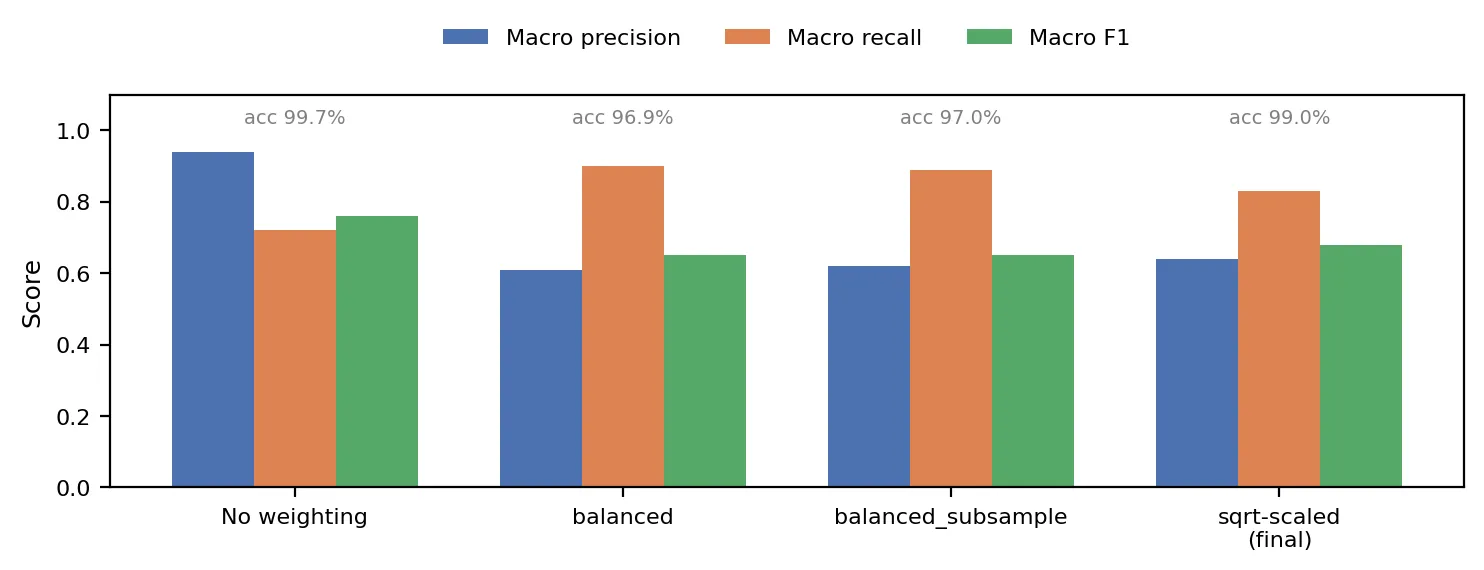
| Strategy | Accuracy | Macro P | Macro R | Macro F1 |
|---|---|---|---|---|
| None | 99.70% | 0.94 | 0.72 | 0.76 |
balanced |
96.90% | 0.61 | 0.90 | 0.65 |
balanced_subsample |
97.03% | 0.62 | 0.89 | 0.65 |
| sqrt-scaled | 98.98% | 0.64 | 0.83 | 0.68 |
Unweighted training maximizes precision but largely ignores rare classes. Full balanced weighting does the opposite: it finds rare attacks but floods you with false alarms on Benign traffic. Sqrt scaling lands in a useful middle, and it had the best macro F1 of the four.
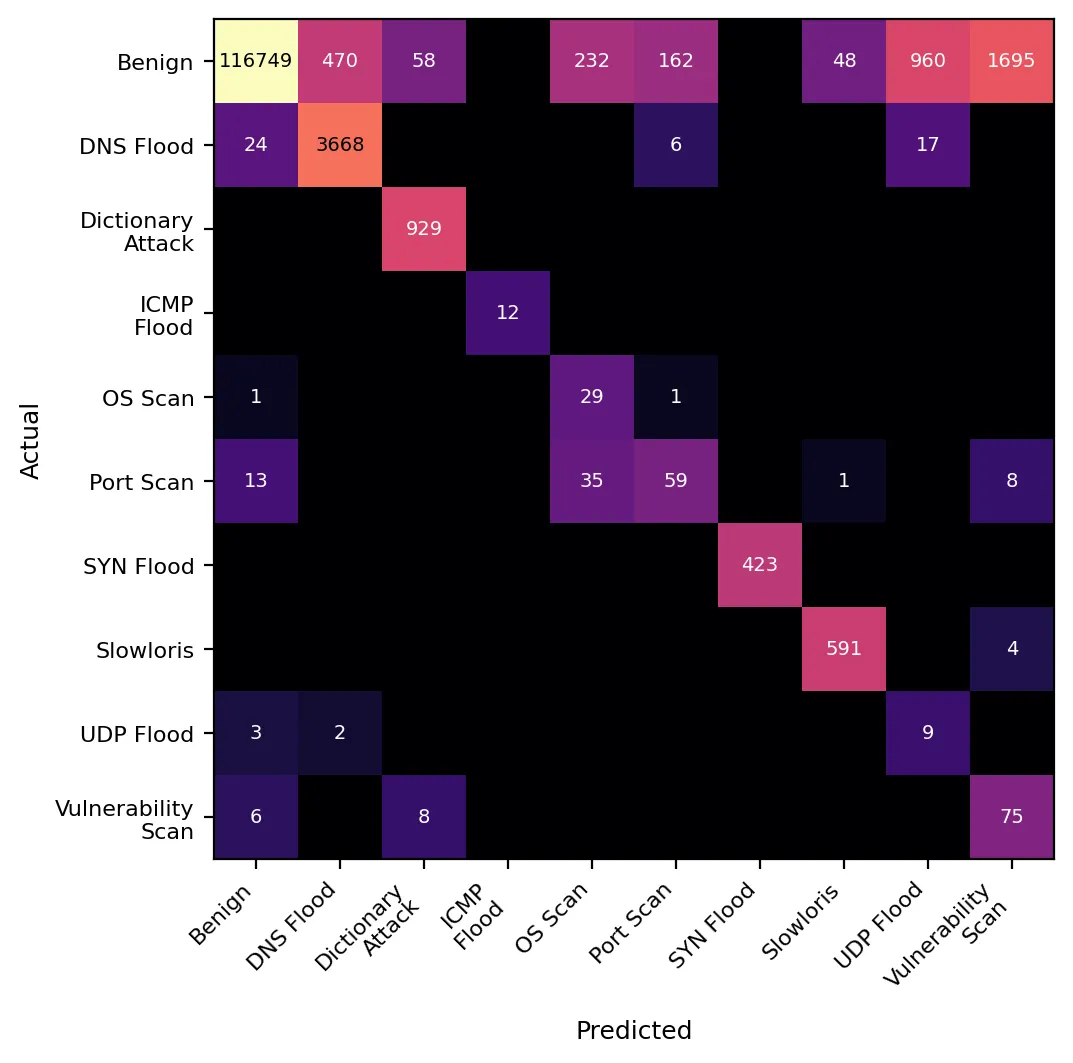
Reading the confusion matrix
The pattern is telling. Attack types are almost never confused with each other. The errors are rare attacks (Port Scan, OS Scan, UDP Flood, Vulnerability Scan) being confused with Benign, and the reverse. Three per-packet features simply do not separate low-volume scan traffic from normal traffic, whatever the weighting.
5. Solution 2: two-stage cascade
If the hard part is Benign versus rare-attack, maybe the 10-way decision is too much to learn at once. So I split it:
- Stage 1: binary Random Forest, Benign vs Attack, using the engineered window features.
- Stage 2: multiclass Random Forest for attack subtype, trained only on true attack rows.
At inference, Stage 2 only sees rows Stage 1 flagged as Attack. That means evaluation has to be end-to-end: an attack that Stage 1 misses can never be rescued by Stage 2.
Tuning Stage 1: where the ceiling is
I swept the Attack class weight over 5, 10, 100, and 200:
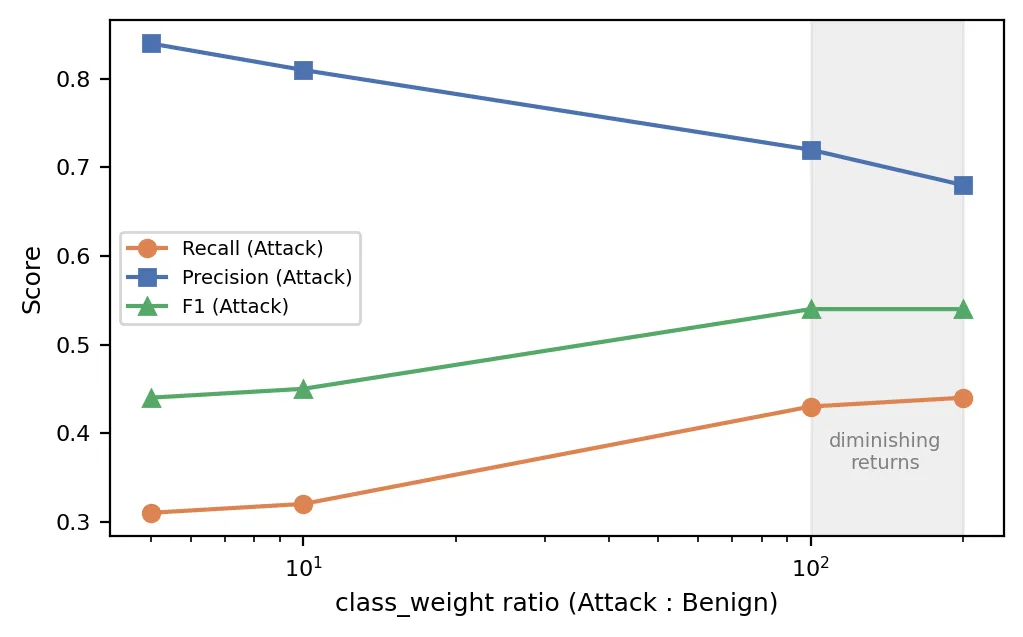
Recall nearly doubles from weight 10 to 100 (0.32 to 0.43), then barely moves from 100 to 200 (0.43 to 0.44) while precision keeps falling. That is the classic diminishing-returns shape: the bottleneck is no longer the weighting.
I then swept the decision threshold with precision_recall_curve, all the way down to a probability cutoff of 0.01. The best it could do was 0.52 recall at 0.30 precision. So neither weight nor threshold can lift the ceiling. The features are the constraint.
What the model actually relies on
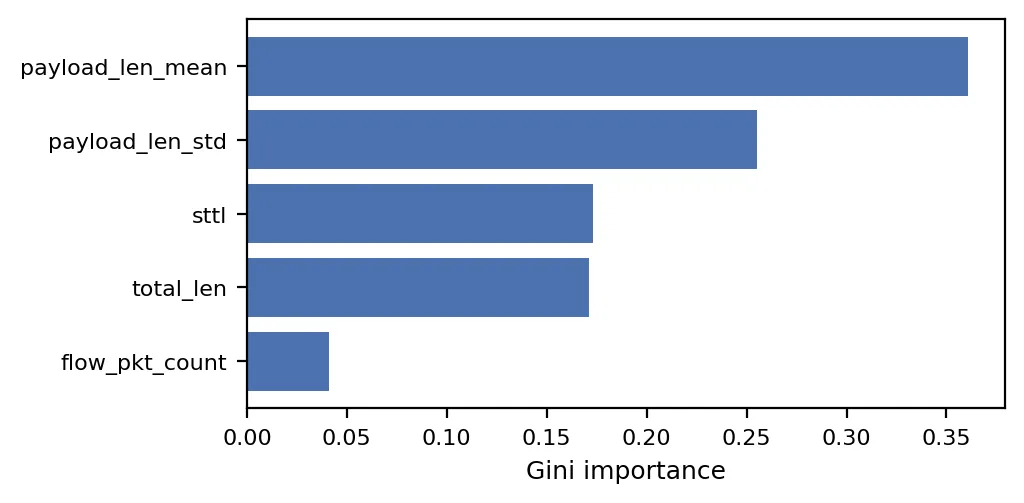
The engineered rolling statistics payload_len_mean (0.361) and payload_len_std (0.255) dominate, ahead of the raw sttl and total_len. So the windowing step added real signal. Meanwhile flow_pkt_count, which I built specifically to catch flood rate, contributes just 0.041 at the binary level. Pooling very different attack types into one “Attack” class dilutes it. Three weak features (protocol_m, sttl_std, unique_dsport_ratio) were pruned with essentially no change in recall.
The final, leak-free result
After fixing all four issues, here is the full cascade evaluated only on classes with genuine multi-session held-out data:
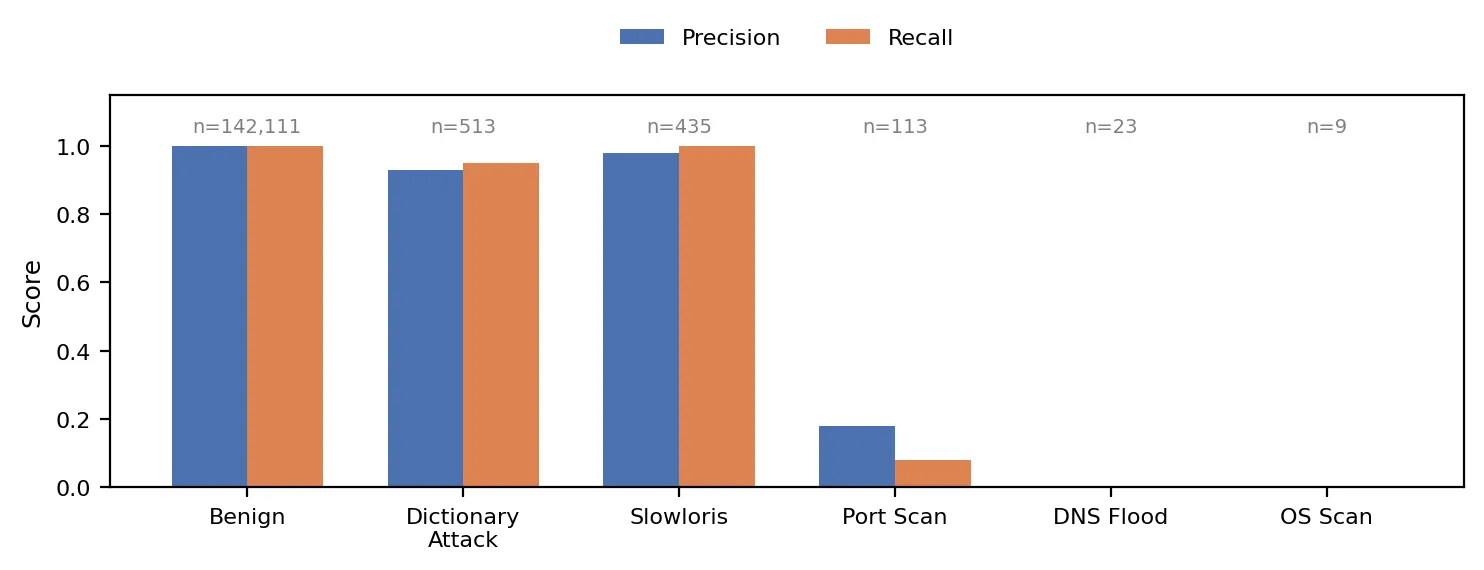
| Class | Precision | Recall | Test support |
|---|---|---|---|
| Benign | 1.00 | 1.00 | 142,111 |
| Dictionary Attack | 0.93 | 0.95 | 513 |
| Slowloris | 0.98 | 1.00 | 435 |
| Port Scan | 0.18 | 0.08 | 113 |
| DNS Flood | 0.00 | 0.00 | 23 |
| OS Scan | 0.00 | 0.00 | 9 |
ICMP Flood, SYN Flood, UDP Flood, and Vulnerability Scan are absent by construction, because single-session classes contribute no held-out sessions. They are not failures, they are untestable.
Dictionary Attack and Slowloris, the two classes with the most multi-session support, hit F1 above 0.9. Port Scan is weak but non-zero. DNS Flood and OS Scan have multiple sessions yet still fail, which tells me the session fix repaired the validity of the evaluation, not the volume of data (23 and 9 test rows is thin).
6. Which solution is better?
| Solution 1 | Solution 2 | |
|---|---|---|
| Architecture | Single 10-class RF | Binary RF, then multiclass RF |
| Leakage audit | Partial | All four sources |
| Headline number | Macro F1 0.68 (sqrt-weighted) | Class-dependent |
| Classes evaluated | 10 (not verified) | 6 of 10 (verified) |
| Deployment | FastAPI app (deployed) | Notebook only |
Solution 1 looks stronger on paper, but I measured it before discovering the duplicate-row and session issues, so its numbers are very likely still partly inflated by the same leaks. Solution 2’s numbers are lower, and they are the only ones I have verified against every leak I found. For the classes both can handle, trust Solution 2.
I deployed the single-stage Random Forest behind a FastAPI endpoint anyway. That is an engineering-simplicity call (one artifact, one inference call), not a claim that it is more accurate.
7. Limitations and what I would do next
- Feature ceiling. Benign-vs-Attack recall plateaus near 0.5 regardless of weighting or threshold. Flow-level features from the companion
ACI-IoT-2023.csv(packet rate, distinct ports contacted, connection duration) are the most promising unexplored fix. - Data volume. Four classes cannot be evaluated at all, and DNS Flood and OS Scan have too few multi-session test rows to learn from.
- Re-audit Solution 1 against the dedup and session-split fixes before trusting its 98.98%.
- Window size. I only tried a 5 s window. 15 s or 30 s may capture slow scans better.
8. What I took away from this
- A very high score is a symptom to investigate, not a result to report. Every leak here announced itself as “too good to be true.”
- Leaks hide behind each other. Fixing identity leakage exposed the preprocessing leak, which exposed duplicates, which exposed the session structure.
- Look at the data’s generation process. The single-session finding came from plotting when each class occurs, not from any model metric.
- Report what you cannot test. Saying “these four classes are not evaluable” is more useful than a precise-looking number that measures nothing.
Links
- Full report (PDF): IoT_Intrusion_Detection_Technical_Report.pdf
- Dataset: ACI-IoT-2023 on Kaggle
- GitHub: github.com/kleofr
- Contact: morehimanish@gmail.com